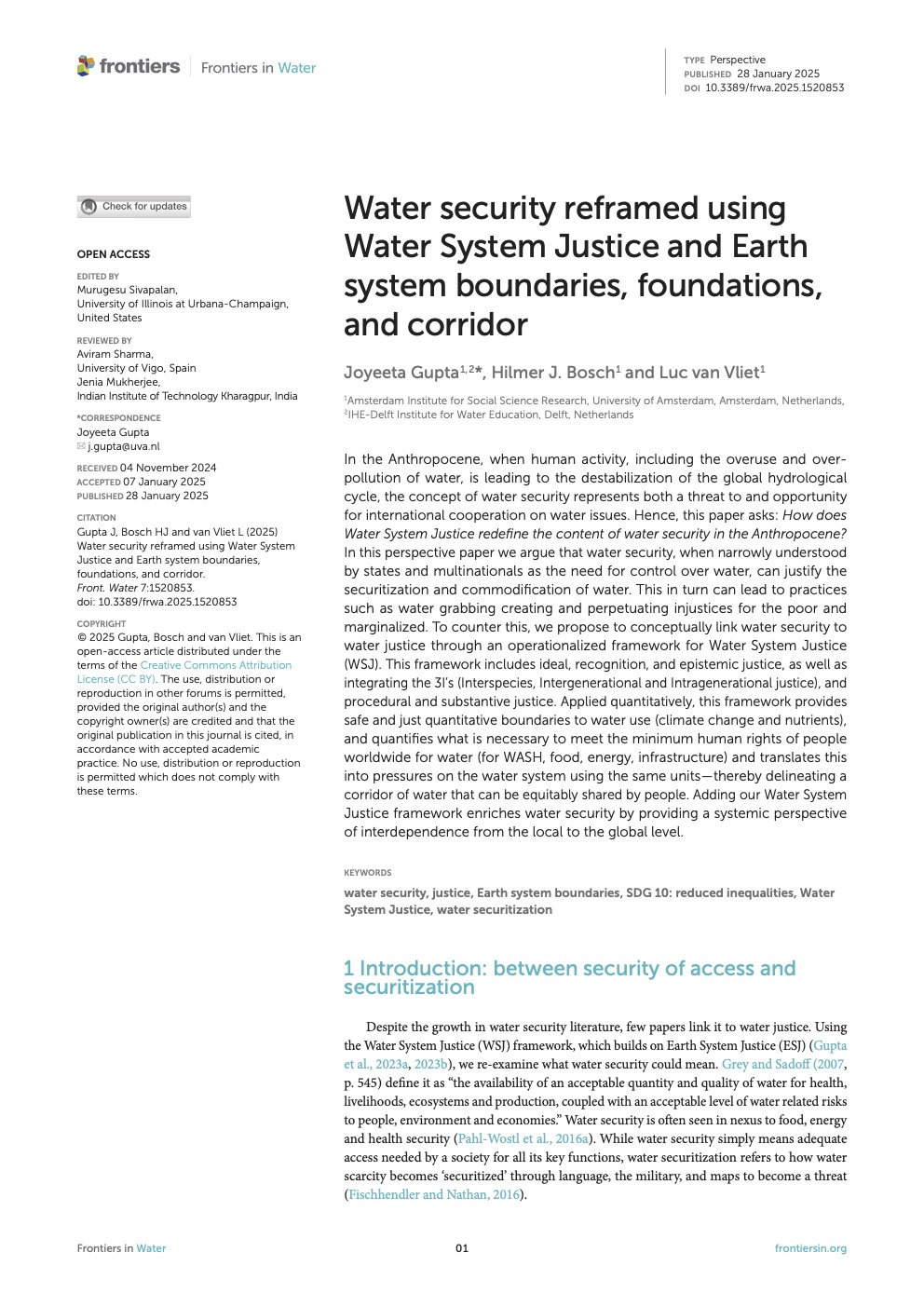
Water security reframed using Water System Justice and Earth system boundaries, foundations, and corridor
Author/s
Joyeeta Gupta, Hilmer J. Bosch, Luc van Vliet
Abstract
In the Anthropocene, when human activity, including the overuse and over-pollution of water, is leading to the destabilization of the global hydrological cycle, the concept of water security represents both a threat to and opportunity for international cooperation on water issues. Hence, this paper asks: How does Water System Justice redefine the content of water security in the Anthropocene? In this perspective paper we argue that water security, when narrowly understood by states and multinationals as the need for control over water, can justify the securitization and commodification of water. This in turn can lead to practices such as water grabbing creating and perpetuating injustices for the poor and marginalized. To counter this, we propose to conceptually link water security to water justice through an operationalized framework for Water System Justice (WSJ). This framework includes ideal, recognition, and epistemic justice, as well as integrating the 3I’s (Interspecies, Intergenerational and Intragenerational justice), and procedural and substantive justice. Applied quantitatively, this framework provides safe and just quantitative boundaries to water use (climate change and nutrients), and quantifies what is necessary to meet the minimum human rights of people worldwide for water (for WASH, food, energy, infrastructure) and translates this into pressures on the water system using the same units—thereby delineating a corridor of water that can be equitably shared by people. Adding our Water System Justice framework enriches water security by providing a systemic perspective of interdependence from the local to the global level.
Gupta J, Bosch HJ and van Vliet L (2025)
Water security reframed using Water System Justice and Earth system boundaries, foundations, and corridor.
Front. Water 7:1520853.
doi: 10.3389/frwa.2025.1520853