Reconciling tracked atmospheric water flows to close the global freshwater cycle
Author/s
Elena De Petrillo, Simon Fahrländer, Marta Tuninetti, Lauren Seaby Andersen, Luca Monaco, Luca Ridolfi, Francesco Laio
Abstract
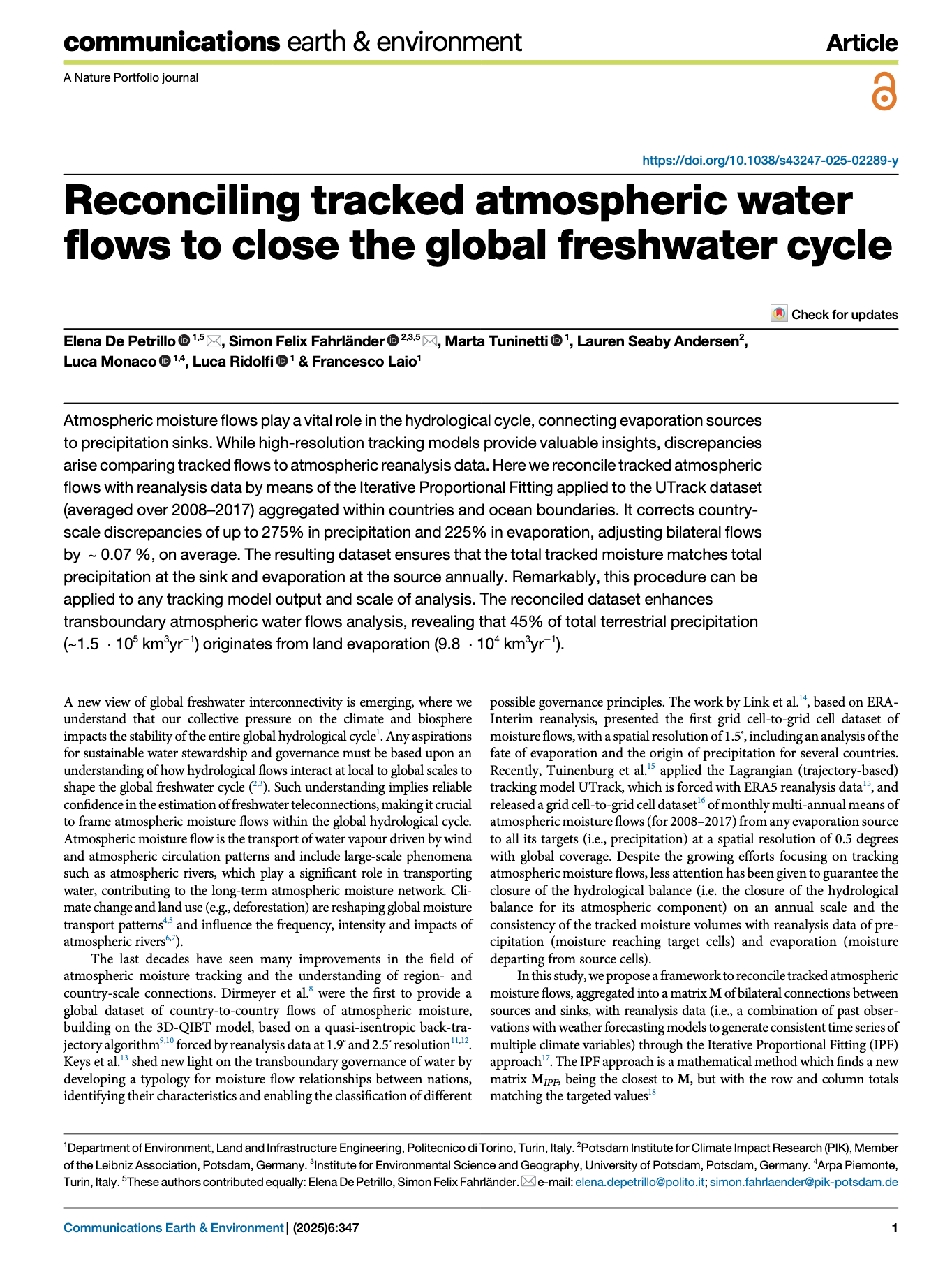
Atmospheric moisture flows play a vital role in the hydrological cycle, connecting evaporation sources to precipitation sinks. While high-resolution tracking models provide valuable insights, discrepancies arise comparing tracked flows to atmospheric reanalysis data. Here we reconcile tracked atmospheric flows with reanalysis data by means of the Iterative Proportional Fitting applied to the UTrack dataset (averaged over 2008–2017) aggregated within countries and ocean boundaries. It corrects country-scale discrepancies of up to 275% in precipitation and 225% in evaporation, adjusting bilateral flows by ~ 0.07 %, on average. The resulting dataset ensures that the total tracked moisture matches total precipitation at the sink and evaporation at the source annually. Remarkably, this procedure can be applied to any tracking model output and scale of analysis. The reconciled dataset enhances transboundary atmospheric water flows analysis, revealing that 45% of total terrestrial precipitation (~1.5 ⋅ 105 km3yr−1) originates from land evaporation (9.8 ⋅ 104 km3yr−1).
Citation
De Petrillo, E., Fahrländer, S.F., Tuninetti, M. et al. Reconciling tracked atmospheric water flows to close the global freshwater cycle. Commun Earth Environ 6, 347 (2025). https://doi.org/10.1038/s43247-025-02289-y